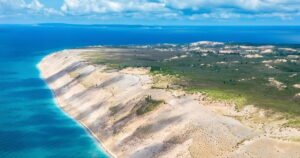
Astola Island
Astola Island sits approximately 25 kilometres off the Balochistan coast in the Arabian Sea, making it the largest offshore island in Pakistan at 6.7 square kilometres. The island is completely uninhabited, which means no hotels, no restaurants, no shops, and no permanent structures beyond a solar-powered lighthouse installed in 1987. What it does have is some of the clearest water on the entire Makran coast, a significant sea turtle nesting population, coral reefs that have not been touched by mass tourism, and a night sky that most Pakistanis living in cities have genuinely never experienced. The island is known locally as Jazeera Haft Talar, which translates to Island of the Seven Hills. Sibi is another top destination to visit on vacation with friends and family.
Quick Facts
| Detail | Info |
| Location | Arabian Sea, 25 km off the Balochistan coast |
| Area | 6.7 square kilometres |
| Also Known As | Jazeera Haft Talar — Island of the Seven Hills |
| Population | Uninhabited — no permanent residents |
| Nearest Town | Pasni, Gwadar District |
| Distance from Pasni | ~39 km by boat |
| Distance from Karachi | ~700 to 750 km by road to Pasni, then boat |
| Best Time to Visit | November to March |
| Closed Season | June to August — rough seas |
| Lighthouse | Solar powered, installed 1987 |
| Accommodation | Camping only — no hotels or structures |
Astola Island History

The Temple and Ancient Significance
Astola Island holds significant religious history for the Hindu community of the region. The island was historically known as Satadip and housed a temple dedicated to the Hindu goddess Kali. The ruins of this temple still stand on the island and are one of the most visited points of interest for people who make the journey out. Kali is one of the most powerful figures in Hindu belief, associated with time, transformation, and destruction, and the temple’s placement on a remote island in the Arabian Sea gives the site an atmosphere that even non-Hindu visitors find genuinely striking. A small mosque dedicated to Pir Khawaja Khizr also exists on the island. Gadani Beach is another good spot to visit whenever planning a trip.
The Lighthouse
The Government of Pakistan installed the first lighthouse on Astola Island in 1982, recognising its importance as a navigational landmark on the Makran coast shipping route. The original structure was replaced by a solar-powered lighthouse in 1987, which continues to operate today. The lighthouse serves as a visual aid for vessels navigating the Arabian Sea along this stretch of coast, emitting light signals that warn sailors of the island’s position and guide them safely through the area.
Why is Astola Called the Island of the Seven Hills?

The island’s Urdu name, Jazeera Haft Talar, translates directly to Island of the Seven Hills. The name refers to the seven distinct hillocks that rise across the island’s surface. These hillocks vary in size and elevation, but their collective presence gives the island its characteristic rolling profile when seen from a boat approaching from the sea. The seven hills are also referenced in local fishing community lore and in the historical records of travellers who visited the island before it became known to the wider Pakistani public.
Astola Island Temple
The Kali temple ruins on Astola Island are among the most historically significant religious sites on the Balochistan coast. The temple served as a centre for the Hindu fishing and trading communities of the region for generations before the island became uninhabited. The ruins that remain today include the structural outline of the original building and some fragments of the stonework, enough to give a clear sense of the temple’s original form.
Astola Island Wildlife

Sea Turtles
Astola Island is one of the most important sea turtle nesting sites in Pakistan. Both endangered green turtles and hawksbill turtles use the island’s beaches as nesting grounds. The nesting season runs through the warmer months, which unfortunately overlaps with the period when the island is closed to visitors due to rough seas. Visitors who time their trip for the October to November transition period have the best chance of witnessing late-season nesting activity or early hatchlings making their way to the water. The island’s uninhabited status and the seasonal closure help protect the nesting beaches from the kind of disturbance that has damaged turtle populations at more accessible coastal sites.
Marine Life and Scuba Diving
The waters surrounding Astola Island support a diverse marine ecosystem. Commercially important species, including tuna, mackerel, and pomfret, are found here alongside colourful reef fish and bottom-dwelling flatfish. Scuba diving at Astola Island is possible, and the underwater visibility is significantly better than at coastal sites. The lack of established diving infrastructure means this is only practical for experienced divers who are comfortable with self-guided exploration in a remote setting. Visibility, current conditions, and depth vary by location around the island, and local fishermen who know the water are the most reliable source of current information before entering.
Seabirds
Astola Island functions as an important breeding ground for several seabird species. Coursers, gulls, plovers, and terns are all present on the island, and the bird activity is particularly noticeable in the early morning and at dusk. The absence of human activity and ground-based predators makes the island an attractive nesting environment for birds that would be more vulnerable on the mainland coast. For visitors with any interest in birdwatching, the island offers sightings that are genuinely difficult to replicate on the accessible Balochistan coastline.
Astola Island Fishing
Astola Island has served as a temporary base for fishermen from Sindh and Balochistan for generations. The primary target is lobster, and the fishing season typically runs from mid-August through December. Fishermen from both provinces travel to the island during this period and stay for anywhere from a week to a month at a time, camping on the island while they work the surrounding waters. The waters around Astola are also productive for tuna and mackerel fishing. The combination of the coral reef ecosystem and the open ocean proximity creates a fish habitat that attracts both reef species and pelagic fish that range widely across the Arabian Sea.
Camping at Astola Island
What to Expect
Camping is the only accommodation option on Astola Island. There are no hotels, no permanent structures available for visitors, and no facilities of any kind beyond the lighthouse. Visitors need to arrive completely self-sufficient with tents, sleeping bags, food, water, cooking equipment, and waste disposal means for the entire duration of the stay. The island has no fresh water source, so every litre needs to come with you from Pasni. Setting up camp on Astola Island is an experience that rewrites your sense of what remote actually means. The silence on the island after the boat leaves is total. No road noise, no generators, no ambient city hum. Just the sea, the wind, and whatever birds are active near camp. Turbat is another destination to follow whenever planning to enjoy wildlife.
Astola Island at Night

The night sky at Astola Island is one of the main reasons people make the considerable effort to get there. With no light pollution within 25 kilometres in any direction, the Milky Way is visible as a solid band across the sky on clear nights. The star density is visibly different from anything accessible from the Pakistani coast, and the experience of lying on the beach looking straight up at it is something I found genuinely difficult to describe to people who have not seen a truly dark sky. Nights can be windy on the island, particularly during the winter months, and the temperature drops noticeably after midnight, even when the afternoon was warm.
Astola Island Weather
| Season | Conditions |
| November to March | Cooler, manageable winds, best visiting conditions |
| April to May | Warming up, still accessible, less predictable |
| June to August | Transition period, seas calming, good for a late-season visit |
| September to October | Transition period, seas calming, good for a late season visit |
The climate on Astola Island is hot and dry for most of the year, with the surrounding Arabian Sea providing some moderation. The best visiting window is November through March, when temperatures are lower, and sea conditions are calm enough for the boat journey from Pasni to be comfortable. The island is effectively inaccessible from June through August due to rough seas, and even experienced local boatmen will not attempt the crossing during this period.
How to Get to Astola Island
The Route
Reaching Astola Island requires two stages. The first is road travel to Pasni in Gwadar District, Balochistan. The second is the boat journey of approximately 39 kilometres from Pasni to the island. There is no other way to reach it. The boat journey from Pasni takes roughly 2 to 3 hours, depending on sea conditions and the type of vessel. Local fishing boats make the crossing regularly, and hiring one for a return trip is the standard arrangement. Negotiating the fare before departure is important as there is no fixed price. Fuel costs, sea conditions, and the length of your intended stay all factor into what the boatman will quote. Going through a known contact or asking at the Pasni port directly gives the most honest pricing.
Distances from Major Cities
| From | Distance and Notes |
| Karachi to Pasni by road | ~700 to 750 km via Makran Coastal Highway |
| Pasni to Astola Island by boat | ~39 km — 2 to 3 hours |
| Islamabad to Pasni by road | ~1,343 km — 18 to 20 hours |
| Quetta to Pasni by road | ~600 to 650 km — 9 to 10 hours |
| Gwadar to Pasni | ~90 km — 1.5 hours |
| Astola Island from Karachi total | Road to Pasni plus boat — plan 2 days minimum |
Astola Island from Karachi
Most visitors from Karachi drive or take transport to Pasni via the Makran Coastal Highway, which also passes through Kund Malir and Ormara. Combining a trip to Astola with stops at Kund Malir and Ormara Beach on the same journey is the most efficient way to cover the Balochistan coast. Reaching Pasni the night before and arranging the boat in the evening for an early morning departure the next day is the practical approach that most experienced visitors follow.
Astola Island and Dajjal
Astola Island is occasionally referenced in discussions about Islamic eschatology because some interpretations of hadith literature have associated remote uninhabited islands in the Arabian Sea with locations mentioned in descriptions of end-time events. The island’s complete isolation and the absence of any permanent population have contributed to this association in popular culture and online discussion. The island itself has no specific official religious designation, and the connection is based on popular interpretation rather than scholarly consensus.
Is Astola Island Safe to Visit?
Astola Island is safe to visit with proper preparation. The primary risks are logistical rather than security-related. The remoteness means that in a genuine emergency, evacuation would be slow and difficult. There are no medical facilities on the island, no communication infrastructure beyond whatever you bring, and sea conditions can change faster than forecasts suggest. The practical safety checklist for a visit is straightforward. Travel with a group rather than alone. Bring more water and food than you calculate you will need. Carry a satellite communicator or GPS beacon for emergencies. Confirm sea conditions with local boatmen before crossing in either direction. Brief someone onshore about your itinerary and expected return time. With those preparations in place, the island is no more dangerous than any other remote camping destination.
My Personal Experience at Astola Island

Getting to Pasni takes long enough that by the time you board the boat the following morning, you have already committed in a way that most day trips to Pakistani tourist spots do not require. The sea crossing takes about two and a half hours, and the island appears on the horizon as a low brown profile well before you can make out any detail. When you get closer, the seven hills become visible, and the colour of the water around the island changes noticeably. It shifts from the blue-grey of open sea to a clearer, greener shade over the shallow reef areas. That watercolour is the first indication that this place is different from the Makran beaches I had visited before. I went to the Kali temple ruins first.
Planning Your Astola Island Trip

Astola Island Trip Cost
The cost of an Astola Island trip varies significantly depending on group size, the boat you hire, and how long you stay. Road transport to Pasni from Karachi has the highest fixed cost. The boat hire from Pasni for a return trip typically runs between PKR 15,000 and PKR 35,000, depending on the vessel and the boatman, and this cost is split among the group, which makes larger groups significantly more economical per person. All food, water, camping equipment, and supplies must be brought from the mainland as nothing is available on the island. There may be local permits or entry requirements for visiting the island as part of broader Balochistan coastal conservation efforts. In addition, Checking current requirements before departure is recommended, as policies in this area have been evolving with the growth of tourism along the Makran coast.
Astola Island Tour Packages
Several Karachi and Gwadar-based tour operators offer Astola Island packages, typically as part of a broader Makran coastal tour that includes Kund Malir, Ormara, and Pasni. These packages cover transport, boat hire, and sometimes camping equipment for visitors who do not have their own gear. For first-time visitors to the Balochistan coast, joining an organised group is a practical option that handles the boat logistics, which are the most uncertain part of the trip to manage independently.
Astola Island Hotels
There are no hotels on Astola Island, and there will not be in the foreseeable future, given its status as a protected uninhabited island. The closest accommodation is in Pasni, which has basic guest houses suitable for the night before and after the boat journey. Gwadar, approximately 90 kilometres from Pasni, has better hotel options for visitors who want more comfortable accommodation as part of a broader Balochistan coastal trip.
Essential Tips
- Visit between November and March for the best sea and weather conditions
- Bring more water than you think you need — the island has no fresh water source
- Arrange the boat in Pasni the evening before for an early morning departure
- Carry a satellite communicator or GPS beacon for emergencies
- Brief someone onshore with your full itinerary and expected return time
- Travel in a group of at least four people for safety and to share boat costs
- Pack warm layers for nights, even if daytime temperatures feel mild
- Carry all waste back to the mainland and leave nothing behind on the island
FAQs
Astola Island is located in the Arabian Sea approximately 25 kilometres off the Balochistan coast of Pakistan, near Pasni in Gwadar District. It is the largest offshore island in Pakistan with an area of 6.7 square kilometres.
The temple on Astola Island is a historic Hindu shrine dedicated to the goddess Kali. The island was historically known as Satadip and the temple served as a religious centre for Hindu fishing communities of the region. Moreover, the ruins still stand and are one of the main points of interest for visitors to the island.
The road distance from Karachi to Pasni, the nearest coastal town to the island, is approximately 700 to 750 kilometres along the Makran Coastal Highway. From Pasni, the boat journey to the island is a further 39 kilometres, taking around 2 to 3 hours.
The island’s Urdu name, Jazeera Haft Talar, translates to Island of Seven Hills. In addition, the name refers to the seven distinct hillocks scattered across the island’s terrain, which give it a characteristic rolling profile visible from a boat.